Abstract
Human Resources functions face persistent operational challenges including administrative overload, fragmented systems, compliance complexity, and reactive decision-making. Studies indicate that HR teams spend between 60–70% of their working hours on manual tasks, leaving limited capacity for strategic contributions. The emergence of artificial intelligence, automation, and integrated data platforms presents a significant opportunity to address these inefficiencies, yet many organizations struggle to realize the full potential of available technologies due to unclear adoption strategies and insufficient understanding of best practices. The purpose of this paper is to examine best practices in HR technology adoption and demonstrate how AI, automation, and data-driven systems can improve the daily operations of HR professionals while elevating the strategic impact of the HR function. This study employs a conceptual analytical framework that synthesizes evidence from four complementary sources: primary source analysis of practitioner-authored HR technology documentation, secondary research from academic journals and industry reports (SHRM, Gartner, Deloitte, McKinsey, IBM, IEEE), comparative evaluation of technology categories across key HR domains, and impact modeling based on quantitative findings from industry benchmarks. Technologies are evaluated across four dimensions: efficiency, accuracy, scalability, and strategic value. The findings demonstrate that organizations embracing HR technology transformation experience measurable improvements, including 30–70% gains in recruitment efficiency, 25% reductions in employee turnover through predictive analytics, 60% fewer scheduling errors via workforce automation, and 20–40% reductions in time spent on reporting. The paper concludes that delayed adoption carries substantial costs in administrative burden, compliance exposure, and missed strategic opportunity, and offers a roadmap for HR leaders seeking to build a scalable, future-ready HR technology ecosystem.
|
Published in
|
Journal of Human Resource Management (Volume 14, Issue 3)
|
|
DOI
|
10.11648/j.jhrm.20261403.12
|
|
Page(s)
|
217-225 |
|
Creative Commons
|

This is an Open Access article, distributed under the terms of the Creative Commons Attribution 4.0 International License (http://creativecommons.org/licenses/by/4.0/), which permits unrestricted use, distribution and reproduction in any medium or format, provided the original work is properly cited.
|
|
Copyright
|
Copyright © The Author(s), 2026. Published by Science Publishing Group
|
Keywords
Artificial Intelligence in HR, HR Technology, Workforce Analytics, Recruitment Automation, Digital HR Transformation, Workforce Management Systems, Compliance Automation, Data-Driven Decision Making
1. Introduction
The modern HR function operates at the intersection of people, technology, and organizational strategy. As workforce expectations evolve and regulatory environments become increasingly complex, HR teams are expected to deliver high-quality employee experiences while simultaneously ensuring compliance, operational efficiency, and strategic alignment. Yet for many HR professionals, the everyday reality falls far short of this ideal. A significant proportion of daily work remains consumed by administrative tasks, data entry, document management, scheduling, policy enforcement, and routine correspondence that, while necessary, offer little strategic value. Studies consistently indicate that HR teams spend between 60-70% of their working hours on manual tasks
| [11] | SHRM. (2024). The State of Artificial Intelligence in HR. SHRM.
shrm.org/topics-tools/news/hr-magazine/state-of-ai-in-hr |
[11]
, leaving limited capacity for the higher-order contributions that organizations genuinely need from their people’s functions. This structural imbalance not only diminishes HR effectiveness but also contributes to elevated burnout rates and accelerated turnover within HR departments themselves.
The emergence of advanced HR technologies presents a powerful and timely opportunity to address these long-standing challenges. Artificial intelligence, machine learning, predictive analytics, and integrated HR platforms collectively offer the ability to automate routine work, elevate decision-making quality, and meaningfully enhance the employee experience across the full employment lifecycle. These are not incremental improvements; they represent a fundamental shift in how HR functions can and should operate. Yet many organizations struggle to realize the full potential of these tools. Fragmented landscapes of technology, unclear adoption strategies, and insufficient understanding of proven best practices continue to limit progress. This whitepaper seeks to close that gap by presenting a comprehensive analysis of HR technology best practices and demonstrating, with specificity and evidence, how they can transform the daily operations of HR teams and the strategic impact of HR functions.
2. Background and Literature Review
2.1. Evolution of HR Technology
HR technology has undergone a remarkable evolution over the past three decades, moving from narrowly transactional systems focused on payroll processing and benefits administration to sophisticated, integrated platforms that enable workforce analytics, AI-driven decision support, and holistic employee experience management. Early human resource information systems (HRIS) were primarily designed for record keeping capturing employee demographics, tracking attendance, and automating basic payroll calculations. While these systems reduced clerical effort, they offered little in the way of strategic insight or workforce intelligence. The introduction of enterprise resource planning (ERP) platforms in the 1990s marked a step forward in integration, but HR modules within these systems remained largely administrative in focus.
The modern generation of cloud-based HR platforms, exemplified by Workday, SAP SuccessFactors, and Oracle HCM Cloud, represents a qualitative leap beyond their predecessors. These platforms integrate talent management, workforce planning, learning and development, compensation, and advanced analytics into unified ecosystems that provide continuous, real-time visibility into the workforce
| [2] | Gartner. (2024). Magic Quadrant for Cloud HCM Suites for Enterprises. Gartner Research. gartner.com/en/documents |
[2]
. The shift from on-premises, siloed systems to cloud-native, API-connected platforms has dramatically reduced the cost and complexity of adoption of HR technology, opening advanced capabilities to organizations of all sizes. Equally important, these platforms are now the foundation upon which AI and machine learning capabilities are being layered, enabling a new class of predictive and prescriptive HR intelligence.
2.2. Challenges in Traditional HR Operations
Despite the availability of advanced technologies, many organizations continue to operate HR functions burdened by fragmented systems, manual processes, and reactive decision-making frameworks. Fragmentation remains one of the most pervasive structural challenges: organizations frequently rely on separate, disconnected platforms for recruitment, payroll, benefits administration, scheduling, learning management, and performance evaluation. The consequence is that employee data exists in multiple incompatible formats across multiple systems, making accurate reporting difficult and increasing the risk of errors and inconsistencies. As SHRM's 2023 HR Technology Report found, 36 percent of HR teams experience data inconsistencies across their systems on a regular basis
| [12] | SHRM. (2024). People Analytics Benchmark Report. SHRM.
shrm.org/hr-today/trends-and-forecasting/research-and-surveys |
[12]
.
Alongside fragmentation, the persistence of manual processes represents a significant drag on HR productivity. Core HR activities such as onboarding, scheduling, compliance tracking, and policy acknowledgment are frequently managed through spreadsheets, email chains, or paper-based forms, approaches that are slow, error-prone, and difficult to audit. SHRM's same report found that 48 percent of HR teams still rely on manual workflows for core processes
| [12] | SHRM. (2024). People Analytics Benchmark Report. SHRM.
shrm.org/hr-today/trends-and-forecasting/research-and-surveys |
[12]
, a figure that underscores the gap between available technology and actual adoption. Finally, traditional HR reporting remains largely descriptive in nature, providing historical summaries of workforce activity rather than forward-looking intelligence. This limits HR's ability to anticipate risks, identify emerging patterns, and make proactive decisions about workforce strategy.
2.3. Academic Foundations of AI in HR
The academic and industry research base supporting AI adoption in HR has expanded substantially in recent years, providing a growing body of evidence for the benefits of intelligent automation and predictive analytics in workforce management. McKinsey & Company has documented that AI-enabled recruitment tools improve hiring efficiency by 30-70%
| [7] | McKinsey & Company. (2023). Artificial Intelligence and the Future of Work. McKinsey Insights.
mckinsey.com/capabilities/people-and-organizational-performance |
[7]
, largely through the automation of candidate screening, matching, and communication tasks that previously required extensive recruiter time. Research from the IBM Smarter Workforce Institute demonstrates that predictive attrition models can reduce employee turnover by as much as 25 percent by identifying at-risk employees before they disengage or resign
| [4] | IBM. (2024). Predictive Attrition Modeling Research. IBM HR Analytics. ibm.com/analytics |
[4]
. LinkedIn's 2024 Workplace Learning Report found that AI-powered learning management systems increase training completion rates by approximately 50 percent compared to traditional instructor-led formats
| [6] | LinkedIn Learning. (2024). 2024 Workplace Learning Report. LinkedIn Learning.
learning.linkedin.com/resources/workplace-learning-report |
[6]
, a finding consistent with broader research on the effectiveness of personalized, self-paced digital learning. The UKG Workforce Institute has further documented that workforce automation platforms reduce scheduling errors by 60 percent, improving both operational efficiency and employee satisfaction
| [13] | UKG Workforce Institute. (2024). The State of Workforce Management. UKG Research. workforceinstitute.org |
[13]
. These findings collectively establish a strong empirical foundation for the best HR technology practices examined throughout this paper.
3. Methodology and Analytical Framework
This paper employs a conceptual analytical framework designed to synthesize evidence from multiple research streams and evaluate HR technology capabilities across the full spectrum of HR operations. The framework draws on four complementary sources of evidence. Primary source analysis grounds the paper in direct examination of practitioner-authored HR technology documentation, with emphasis on operational specifics and real-world implementation contexts. Secondary research encompasses academic journals, industry reports from leading research organizations including SHRM, Gartner, Deloitte, McKinsey, and IBM, as well as IEEE publications that address the computational and systems-level dimensions of AI in enterprise environments. Comparative evaluation provides a structured basis for assessing how different technology categories, from applicant tracking systems to workforce management platforms to compliance automation engines, address common HR challenges with varying degrees of effectiveness. Impact modeling synthesizes quantitative findings from industry research to estimate the aggregate workforce and cost implications of technology adoption across key HR domains.
Technologies examined in this paper are evaluated across four analytical dimensions that collectively capture the full value proposition of HR technology transformation. Efficiency captures the time savings, throughput improvements, and automation impact delivered by a given technology. Accuracy encompasses the improvements in data quality, error reduction, and compliance reliability that result from replacing manual processes with intelligent automation. Scalability addresses the degree to which technology can support global operations, accommodate organizational growth, and integrate with adjacent systems without proportional increases in administrative burden. Strategic value reflects the degree to which technology enables better decision-making, deeper workforce intelligence, and stronger alignment between HR operations and organizational goals. Together, these dimensions provide a comprehensive lens for evaluating the practical and strategic impact of HR technology investments.
4. AI-Powered Recruitment and Talent Acquisition
Recruitment is among the most resource-intensive and strategically consequential functions within HR. Traditional recruitment processes are characterized by extensive manual effort: recruiters spend most of their time on activities such as posting job descriptions, reviewing resumes, scheduling interviews, and managing candidate communications, tasks that are time-consuming, subjective, and difficult to standardize across the organization. These inefficiencies translate directly into longer hiring cycles, inconsistent candidate evaluation, elevated costs, and recruiter burnout. The impact on organizational performance is substantial: extended vacancies create productivity losses, unfilled roles strain existing teams, and poor hiring decisions generate downstream costs in training, performance management, and eventual replacement. The transformation of recruitment through AI represents one of the highest-value applications of HR technology, with documented impacts that are both significant and reproducible.
4.1. Automation of Screening and Matching
AI-driven applicant tracking systems leverage natural language processing to parse resumes at scale, identify qualified candidates against predefined criteria, and rank applicants in ways that surface the strongest matches for recruiter review. Rather than requiring recruiters to manually evaluate hundreds of applications for each open role, AI systems handle initial screening automatically, presenting recruiters with a prioritized shortlist of candidates who meet the core requirements. Research published in IEEE Transactions on Computational Social Systems demonstrates that AI-based resume screening improves match accuracy by 35 percent compared to manual review
| [5] | IEEE Access. (2023). AI Enabled Data Governance in Enterprise Systems. IEEE Access Journal. ieeexplore.ieee.org |
[5]
, a finding attributed to the system's ability to evaluate a broader range of signals consistently and without the fatigue effects that degrade human judgment over time. This automation allows recruiters to redirect their attention toward higher-value activities such as candidate engagement, cultural fit assessment, and hiring manager collaboration.
4.2. Reduction in Time and Cost Per Hire
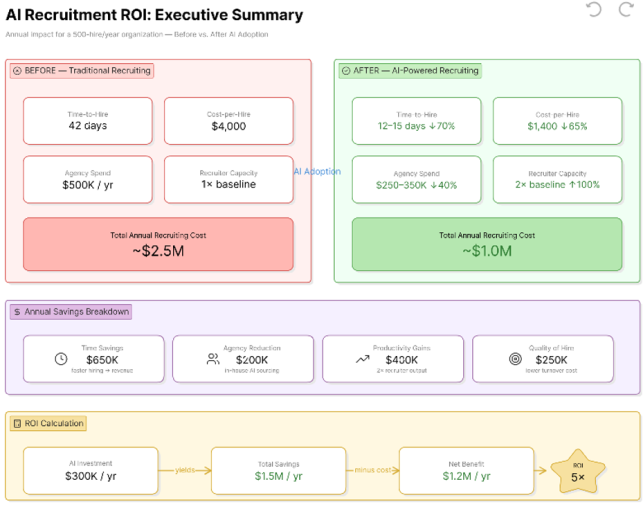
The financial and temporal benefits of AI-powered recruitment are well documented. AI tools have been shown to reduce the average U. S. hiring cycle from approximately 42 days to between 12 and 15 days, a compression of roughly 70 percent that accelerates time-to-productivity for new hires and reduces the cumulative cost of extended vacancies
| [7] | McKinsey & Company. (2023). Artificial Intelligence and the Future of Work. McKinsey Insights.
mckinsey.com/capabilities/people-and-organizational-performance |
[7]
. Cost per hire reductions of up to 65 percent have been reported by organizations that have implemented AI recruitment platforms at scale, driven primarily by reductions in job board spending, decreased reliance on external recruitment agencies, and dramatically lower manual screening hours
| [11] | SHRM. (2024). The State of Artificial Intelligence in HR. SHRM.
shrm.org/topics-tools/news/hr-magazine/state-of-ai-in-hr |
[11]
. Generative AI tools further contribute to cost efficiency by automating the creation of job descriptions, interview guides, offer letters, and candidate communications, ensuring consistency while reducing the administrative burden on HR staff. E-recruiting platforms that publish postings simultaneously across thousands of job boards and professional networks expand candidate reach at minimal incremental cost, improving pipeline quality without proportional increases in recruiter effort.
4.3. Bias Detection and Diversity Outcomes
One of the most significant and often underappreciated benefits of AI in recruitment is its capacity to detect and mitigate patterns of bias in screening decisions. Human recruitment processes are susceptible to a wide range of cognitive biases, affinity bias, recency effects, name-based discrimination, and others, that can systematically disadvantage qualified candidates from underrepresented groups. AI systems, when designed and audited appropriately, can apply evaluation criteria consistently across all candidates without the influence of these biases. Research from Harvard Business Review indicates that organizations that implement algorithmic auditing of their recruitment processes see improvements in diversity outcomes of between 20 and 30 percent
| [3] | Harvard Business Review. (2024). How AI Is Transforming Leadership Development. HBR. hbr.org |
[3]
. While AI systems can themselves encode bias if trained on historically biased data, organizations that proactively monitor and audit their AI recruitment tools are better positioned to achieve fairer, more inclusive hiring outcomes.
4.4. Recruiter Productivity and Cost Savings
Beyond hiring cycle compression and cost per hire reduction, AI fundamentally changes the economics of the recruiting function by enabling individual recruiters to manage significantly larger requisition loads without a corresponding decline in quality or candidate experience. AI-enabled recruiters have been documented to manage twice as many open roles as their non-AI counterparts, effectively doubling team capacity without additional headcount. The annualized financial value of this productivity improvement is estimated at between $80,000 and $120,000 per recruiter in reduced agency fees, avoided headcount costs, and efficiency gains
| [8] | McKinsey & Company. (2025). HR’s Transformative Role in an Agentic Future. McKinsey Insights.
mckinsey.com/capabilities/people-and-organizational-performance |
[8]
. For organizations with large or growing recruitment functions, these savings can represent a compelling return on investment that justifies technology adoption well before accounting for the broader strategic benefits of faster, more accurate hiring.
Figure 1. AI Recruitment ROI.
5. HRIS and Centralized Data Management
A centralized HRIS platform serves as the operational backbone of a modern HR technology ecosystem. By consolidating employee data from across the organization into a single, authoritative system of records, organizations can eliminate the data silos that generate reporting errors, compliance gaps, and operational friction. Modern HRIS platforms such as Workday, SAP SuccessFactors, and Rippling offer comprehensive capabilities that span the entire employee lifecycle, from initial onboarding through career development, compensation management, and eventual offboarding
| [2] | Gartner. (2024). Magic Quadrant for Cloud HCM Suites for Enterprises. Gartner Research. gartner.com/en/documents |
[2]
. The strategic value of centralization, however, extends well beyond administrative convenience: a unified data foundation enables advanced analytics, AI-driven insights, and cross-functional workflow automation that characterize the most effective HR technology ecosystems.
5.1. Intelligent Data Quality Management
AI strengthens HRIS platforms by continuously scanning employee records for inconsistencies, missing fields, duplicate entries, and outdated information. Instead of relying on manual audits, AI automatically identifies errors and recommends corrections, ensuring that the centralized employee database remains accurate and reliable. This improves data integrity across the entire HR ecosystem and reduces the risk of downstream reporting issues.
5.2. Automated Document Digitization and Classification
AI accelerates the digitization of HR documents by automatically extracting information from forms, contracts, and compliance files and categorizing them into the correct HRIS modules. Natural language processing (NLP) enables AI to read, tag, and store documents with high accuracy, eliminating manual filing and ensuring that employees and HR teams can instantly access the information they need.
5.3. Enhanced Role-Based Access and Data Governance
AI improves data governance by analyzing access patterns and recommending optimal role based permissions. It can detect unusual access behavior, flag potential security risks, and ensure that sensitive employee data is only accessible to authorized users. This strengthens compliance with privacy regulations such as GDPR, CCPA, and HIPAA while reducing the administrative burden of managing permissions manually.
5.4. Seamless System Integrations and Unified Employee Records
AI simplifies integrations between HRIS, payroll, time and attendance, benefits, and performance systems by mapping data fields, identifying mismatches, and automating reconciliation. This creates a unified employee record that flows consistently across platforms, reducing manual data entry and eliminating discrepancies that often occur in multi system environments.
5.5. Predictive Insights from Centralized Data
Once data is centralized, AI unlocks advanced analytics by identifying patterns in turnover, absenteeism, compensation, performance, and workforce demographics. Predictive models help HR leaders anticipate risks, forecast workforce needs, and make more informed decisions. This transforms the HRIS from a transactional system into a strategic intelligence engine that supports long term planning.
5.6. Automated Workflow Optimization
AI analyzes HR workflows, such as onboarding, offboarding, promotions, and policy acknowledgments, to identify bottlenecks and recommend process improvements. It can automatically route tasks, trigger reminders, and ensure that steps are completed in the correct sequence. This reduces cycle times, improves employee experience, and ensures consistent execution of HR processes across the organization.
5.7. Personalized Employee Self-Service
AI enhances HRIS self service portals by enabling conversational interfaces that help employees find information, update records, request documents, or complete tasks without HR intervention. AI powered assistants can answer policy questions, guide employees through forms, and provide personalized recommendations, reducing HR ticket volume and improving employee satisfaction.
5.8. Strengthened Compliance and Audit Readiness
AI continuously monitors data changes, tracks document expirations, and ensures that required forms and certifications are up to date. Automated audit trails capture every modification to employee records, providing a transparent and defensible compliance history. This reduces audit preparation time and ensures that HR teams are always ready for internal or external reviews.
6. HR Analytics and Predictive Decision Making
Data driven decision making has become a defining capability of high-performing HR functions, and the shift from descriptive to predictive analytics represents one of the most consequential advances available to HR leaders today. Traditional HR reporting has historically focused on retrospective metrics, headcount summaries, turnover rates for the prior quarter, training completion statistics, that describe what has already occurred but offer limited guidance about what is likely to happen next. Predictive analytics inverts this orientation by analyzing historical patterns and identifying the leading indicators that precede significant workforce events, enabling HR teams to intervene proactively rather than respond reactively. The organizational value of this shift is difficult to overstate: the difference between knowing that attrition increased last quarter and knowing which employees are at elevated risk of leaving in the next 90 days represents a fundamentally different strategic posture
| [4] | IBM. (2024). Predictive Attrition Modeling Research. IBM HR Analytics. ibm.com/analytics |
[4]
.
Modern HR analytics platforms provide self-service dashboards that empower HR business partners and line managers to access workforce insights without depending on data science teams or IT support. This democratization of data shortens decision-making cycles and enables more distributed, evidence-based management across the organization. Key metrics tracked through these platforms, including turnover rate, cost per hire, return on human capital, absenteeism frequency, and expenses per employee, provide a comprehensive and continuously updated view of workforce health and performance
| [12] | SHRM. (2024). People Analytics Benchmark Report. SHRM.
shrm.org/hr-today/trends-and-forecasting/research-and-surveys |
[12]
. Anomaly detection capabilities further enhance operational visibility by flagging unusual patterns in time and attendance, scheduling, and productivity data that may indicate emerging compliance risks, workload imbalances, or early signs of disengagement.
Organizations that have been committed to predictive HR analytics consistently report measurable improvements across multiple dimensions of workforce performance. Research synthesized from industry benchmarks indicates that HR teams using advanced analytics platforms experience a 20-40% reduction in time spent on reporting and analysis
, as automated data collection, aggregation, and visualization replace the manual effort of assembling reports from multiple systems. Workforce planning cycles become significantly faster when forecasting is automated rather than manually constructed, enabling HR leaders to respond more quickly to changes in business conditions. Perhaps most consequentially, predictive models reduce the time spent on reactive interventions by identifying risks earlier: when attrition, absenteeism, and overtime spikes are anticipated rather than discovered after the fact, HR teams can deploy targeted retention strategies, wellness programs, and scheduling adjustments that address root causes before they escalate
| [9] | McKinsey Global Institute. (2024). A Future That Works: Automation, Employment, and Productivity. McKinsey Global Institute. mckinsey.com/mgi |
[9]
. This transition from reactive firefighting to proactive strategy development represents a fundamental elevation of the HR function's organizational role.
7. Learning, Development, and Virtual Management
Learning and development occupy a central position in employee engagement, retention, and organizational capability building. The challenge for many organizations has been those traditional approaches to workforce development classroom training sessions, periodic compliance courses, generalized skill-building programs, are expensive to deliver, difficult to scale, and frequently misaligned with the specific development needs of individual employees. Virtual learning management systems have substantially addressed the scalability and cost challenges by enabling employees to complete training at their own pace and on their own schedule, eliminating the logistical overhead of in-person instruction. The more transformative development, however, is the application of AI to the learning function itself, which shifts the learning experience from generic and passive to personalized, predictive, and continuously adaptive.
AI enhances learning by conducting precise skill gap analysis using performance data, role requirements, and individual career aspirations, then constructing personalized learning pathways that target each employee's specific development needs rather than prescribing the same curriculum to all. AI-driven recommendation engines function as a kind of personalized learning concierge, surfacing courses, microlearning modules, and certification programs that are directly relevant to an employee's current role and future goals
| [6] | LinkedIn Learning. (2024). 2024 Workplace Learning Report. LinkedIn Learning.
learning.linkedin.com/resources/workplace-learning-report |
[6]
. This targeted approach reduces the time employees spend searching for relevant content and accelerates both upskilling and reskilling efforts. The 2024 LinkedIn Workplace Learning Report documents that AI-powered learning systems increase training completion rates by approximately 50 percent compared to traditional formats, a finding attributed to the combination of personalization, convenience, and just-in-time delivery that AI enables.
Generative AI is also transforming the production of training content, significantly reducing the workload on learning and development teams by automatically generating microlearning modules, quizzes, onboarding guides, and policy summaries that would previously have required days of manual effort to create. This automation ensures that training content remains current, consistent, and scalable while freeing L&D professionals to focus on strategic program design rather than content production
| [10] | MIT Sloan Management Review. (2023). AI Driven Learning Ecosystems. MIT SMR. sloanreview.mit.edu |
[10]
. AI-powered coaching tools extend the reach of development by providing employees with real-time feedback on communication, leadership, and presentation skills through simulations and behavioral analysis, making high-quality development accessible to a broader workforce at a fraction of the cost of traditional in-person coaching.
AI also plays a critical role in retention by analyzing learning patterns, participation levels, and skill progression to identify employees who may be disengaging or at elevated risk of leaving. Signals such as declining training activity or stalled development trajectories can trigger early HR interventions that address retention risks before they materialize as departures. For compliance and onboarding specifically, AI improves completion rates by automating reminders, tracking progress, and delivering short, focused microlearning modules that are easier for busy employees to complete. For new hires, AI-driven onboarding pathways accelerate the ramp-up period and ensure consistent delivery of critical information regardless of location, role, or manager. Finally, AI supports managers of distributed and hybrid teams by analyzing collaboration patterns, workload distribution, and sentiment indicators to flag burnout risks, identify coaching opportunities, and provide actionable insights for maintaining team engagement and productivity
| [3] | Harvard Business Review. (2024). How AI Is Transforming Leadership Development. HBR. hbr.org |
[3]
.
8. Workforce Management and Scheduling Automation
Workforce management is among the most operationally intensive areas of HR, characterized by a high volume of daily decisions, scheduling, time tracking, compliance monitoring, overtime management, that are individually routine but collectively represent a substantial administrative burden. Manual approaches to workforce management create persistent challenges: missed time punches require investigation and correction, scheduling conflicts generate employee dissatisfaction and coverage gaps, overtime breaches trigger compliance risk, and the absence of real-time visibility makes proactive management nearly impossible. Workforce management platforms such as UKG and Kronos have substantially automated many of these tasks, and the integration of AI into these platforms has elevated their capabilities from reactive tools to intelligent, forward-looking systems that anticipate workforce challenges before they occur
| [13] | UKG Workforce Institute. (2024). The State of Workforce Management. UKG Research. workforceinstitute.org |
[13]
.
8.1. Automated Anomaly Detection and Real-Time Alerts
AI continuously monitors time and attendance data, automatically flagging missed punches, scheduling conflicts, and irregularities with instant supervisor alerts, reducing manual review and payroll errors.
8.2. Predictive Scheduling and Shift Optimization
Machine learning analyzes historical patterns, demand, and employee preferences to generate optimized schedules, reducing last-minute changes, unnecessary overtime, and improving employee satisfaction.
8.3. Intelligent Overtime and Compliance Prevention
AI proactively identifies potential overtime breaches and labor rule violations before they occur, recommending schedule adjustments to reduce legal risk and overtime costs.
8.4. Automated Schedule Generation and Labor Forecasting
AI forecasts labor demand using business data (sales, traffic, production) to auto-generate fair, optimized schedules, eliminating hours of manual work.
8.5. Enhanced BI Dashboard Integration
AI delivers predictive insights on labor trends, absenteeism, and overtime risk through dynamic dashboards, enabling forward-looking workforce decisions and accurate budgeting.
8.6. Standardized Pay Profiles and Automated Rule Enforcement
AI auto-applies pay codes, labor rules, and compliance requirements by jurisdiction reducing pay inconsistencies and manual corrections.
8.7. Reduction of Manual Review and Admin Work
Automation handles scheduling, anomaly detection, and compliance checks that previously required daily HR intervention, freeing teams for strategic planning.
8.8. Improved Employee Experience and Schedule Adherence
AI-powered tools offer predictable schedules, self-service shift swaps, and automated notification boost engagement, reducing absenteeism, and lowering turnover.
8.9. Automated Leave Balance Calculator
Employees and managers frequently struggle to understand complex accrual rules involving tenure tiers, carryover limits, and proration formulas, generating a high volume of repetitive HR queries. AI-powered self-service calculators allow employees to input their hire date, country, and leave type to instantly view projected balances, carryover amounts, and expiry dates. This automation reduces HR ticket volume, empowers employees with transparent and accurate information, and eliminates confusion around leave entitlements.
8.10. Working Hour Compliance Analyzer
Scheduling teams often lack real-time visibility into whether shift patterns comply with working hour regulations, including maximum weekly hours, mandatory rest periods between shifts, and limits on consecutive working days. AI-driven compliance analyzers continuously read schedule data and proactively flag violations, identifying associates who exceed weekly hour limits, have insufficient rest between shifts, or are assigned too many consecutive working days. This tool catches compliance violations before they reach payroll, reducing legal risk and ensuring employee wellbeing.
9. Legal, Compliance, and Policy Automation
Compliance is among the most consequential and demanding responsibilities of the HR function, particularly for organizations operating across multiple jurisdictions with distinct regulatory frameworks. The complexity of employment law, encompassing federal, state, and local labor regulations, industry-specific requirements, international employment standards, and evolving privacy laws, makes comprehensive manual compliance management not merely inefficient but genuinely untenable for organizations of any significant scale. A single missed regulatory update can expose the organization to penalties, litigation, and reputational harm, while the cumulative administrative burden of tracking compliance obligations manually diverts HR capacity from higher-value work. Automated compliance monitoring tools and AI-powered policy management systems represent a fundamental improvement over manual approaches, offering continuous, real-time oversight of regulatory obligations across all jurisdictions in which the organization operates.
9.1. Real-Time Regulatory Intelligence
AI continuously scans federal, state, and international regulatory databases to identify new laws, policy updates, and compliance obligations. Instead of relying on manual tracking, AI automatically interprets regulatory changes and alerts HR teams to required actions. This ensures organizations stay compliant across multiple jurisdictions and dramatically reduces the risk of missing critical updates.
9.2. Automated Compliance Monitoring
AI powered compliance engines monitor HR transactions, payroll data, leave requests, and policy exceptions in real time. By comparing employee actions against labor laws and internal rules, AI flags potential violations before they occur. This proactive monitoring reduces audit findings, minimizes legal exposure, and ensures consistent enforcement of policies across the workforce.
9.3. AI-Generated Audit Trails and Documentation
AI automatically creates detailed audit trails for every policy change, approval, exception, and compliance related decision. These logs are time stamped, tamper resistant, and easily exportable for auditors. This eliminates the manual effort of assembling documentation and provides a defensible compliance record that strengthens the organization’s legal posture.
9.4. Automated Leave and Policy Enforcement
AI enforces leave policies, attendance rules, and eligibility criteria by applying labor regulations consistently across all employee groups. It validates requests, checks balances, and ensures compliance with jurisdiction specific requirements such as FMLA, state leave laws, or global equivalents. This reduces manual review time and prevents inconsistent or incorrect policy application.
9.5. Intelligent Risk Detection and Early Warning Systems
AI analyzes patterns in employee behavior, scheduling, overtime, and leave usage to detect emerging compliance risks. For example, it can identify patterns that may indicate potential wage and hour violations, misclassification risks, or repeated policy exceptions. Early detection allows HR to intervene before issues escalate into legal disputes or penalties.
9.6. Streamlined Global Compliance Through EOR Platforms
AI enabled Employer of Record (EOR) platforms simplify global hiring by automating payroll tax calculations, statutory benefits, employment contracts, and country specific compliance requirements. AI ensures that every employee, regardless of location, is managed according to local labor laws, reducing the complexity and cost of global expansion.
9.7. Policy Interpretation and Automated Guidance
AI can interpret complex policy language and provide real time guidance to HR teams, managers, and employees. When someone asks a question about eligibility, compliance rules, or policy exceptions, AI can instantly reference the correct regulation and provide an accurate answer. This reduces HR workload and improves policy clarity across the organization.
9.8. Faster Audit Readiness and Response
AI centralizes compliance data, automates documentation, and provides instant access to audit ready reports. During internal or external audits, HR teams can quickly retrieve required evidence, reducing audit preparation time from weeks to hours. This improves transparency, reduces stress on HR teams, and strengthens overall compliance maturity.
10. Conclusion
HR technology transformation has crossed the threshold from competitive advantage to organizational necessity. The evidence reviewed in this paper makes clear that the gap between organizations that have embraced AI, automation, and data-driven decision making in their HR functions and those that have not is growing, and that the costs of delayed adoption, measured in administrative burden, compliance exposure, talent loss, and missed strategic opportunity, are substantial. The technologies discussed in this paper, AI-powered recruitment platforms, integrated HRIS ecosystems, predictive analytics engines, personalized learning management systems, automated workforce management tools, and intelligent compliance monitoring platforms, are not theoretical constructs. They are mature, proven solutions that organizations of all sizes are deploying today with documented, measurable results.
The path to transformation begins with an honest assessment of current pain points: where are HR teams spending disproportionate time on manual tasks? Where are data inconsistencies creating compliance risk or decision-making blind spots? Where are reactive processes substituting for proactive strategy? The answers to these questions identify the highest-priority candidates for technology investment. From this foundation, organizations can build a phased roadmap that delivers quick wins in the near term while progressively advancing toward a fully integrated, analytics-driven HR technology ecosystem. The goal is not the technology itself, but what the technology enables: HR professionals who are freed from administrative burden, equipped with actionable intelligence, and empowered to do the most important work of their careers, building the organizations, teams, and cultures that enable people to thrive.
Abbreviations
HR | Human Resources |
IT | Information Technology |
T&A | Time and Attendance |
API | Application Programming Interface |
HCM | Human Capital Management |
AWS | Amazon Web Services |
ML | Machine Language |
UX | User Experience |
Author Contributions
Vidyullatha Satti: Conceptualization, Investigation, Methodology, Writing – original draft, Writing – review & editing
Conflicts of Interest
The author declares no conflicts of interest.
References
| [1] |
Deloitte. (2024). 2024 Global Human Capital Trends. Deloitte Insights.
www2.deloitte.com/global/en/pages/human-capital
|
| [2] |
Gartner. (2024). Magic Quadrant for Cloud HCM Suites for Enterprises. Gartner Research. gartner.com/en/documents
|
| [3] |
Harvard Business Review. (2024). How AI Is Transforming Leadership Development. HBR. hbr.org
|
| [4] |
IBM. (2024). Predictive Attrition Modeling Research. IBM HR Analytics. ibm.com/analytics
|
| [5] |
IEEE Access. (2023). AI Enabled Data Governance in Enterprise Systems. IEEE Access Journal. ieeexplore.ieee.org
|
| [6] |
LinkedIn Learning. (2024). 2024 Workplace Learning Report. LinkedIn Learning.
learning.linkedin.com/resources/workplace-learning-report
|
| [7] |
McKinsey & Company. (2023). Artificial Intelligence and the Future of Work. McKinsey Insights.
mckinsey.com/capabilities/people-and-organizational-performance
|
| [8] |
McKinsey & Company. (2025). HR’s Transformative Role in an Agentic Future. McKinsey Insights.
mckinsey.com/capabilities/people-and-organizational-performance
|
| [9] |
McKinsey Global Institute. (2024). A Future That Works: Automation, Employment, and Productivity. McKinsey Global Institute. mckinsey.com/mgi
|
| [10] |
MIT Sloan Management Review. (2023). AI Driven Learning Ecosystems. MIT SMR. sloanreview.mit.edu
|
| [11] |
SHRM. (2024). The State of Artificial Intelligence in HR. SHRM.
shrm.org/topics-tools/news/hr-magazine/state-of-ai-in-hr
|
| [12] |
SHRM. (2024). People Analytics Benchmark Report. SHRM.
shrm.org/hr-today/trends-and-forecasting/research-and-surveys
|
| [13] |
UKG Workforce Institute. (2024). The State of Workforce Management. UKG Research. workforceinstitute.org
|
Cite This Article
-
APA Style
Satti, V. (2026). HR Tech Best Practices: Improving Daily HR Life and Performance Through AI, Automation, and Data Driven Transformation. Journal of Human Resource Management, 14(3), 217-225. https://doi.org/10.11648/j.jhrm.20261403.12
 Copy
|
Copy
|
 Download
ACS Style
Satti, V. HR Tech Best Practices: Improving Daily HR Life and Performance Through AI, Automation, and Data Driven Transformation. J. Hum. Resour. Manag. 2026, 14(3), 217-225. doi: 10.11648/j.jhrm.20261403.12
Copy
|
Download
AMA Style
Satti V. HR Tech Best Practices: Improving Daily HR Life and Performance Through AI, Automation, and Data Driven Transformation. J Hum Resour Manag. 2026;14(3):217-225. doi: 10.11648/j.jhrm.20261403.12
Copy
|
Download
-
@article{10.11648/j.jhrm.20261403.12,
  author = {Vidyullatha Satti},
  title = {HR Tech Best Practices: Improving Daily HR Life and Performance Through AI, Automation, and Data Driven Transformation},
  journal = {Journal of Human Resource Management},
  volume = {14},
  number = {3},
  pages = {217-225},
  doi = {10.11648/j.jhrm.20261403.12},
  url = {https://doi.org/10.11648/j.jhrm.20261403.12},
  eprint = {https://article.sciencepublishinggroup.com/pdf/10.11648.j.jhrm.20261403.12},
  abstract = {Human Resources functions face persistent operational challenges including administrative overload, fragmented systems, compliance complexity, and reactive decision-making. Studies indicate that HR teams spend between 60–70% of their working hours on manual tasks, leaving limited capacity for strategic contributions. The emergence of artificial intelligence, automation, and integrated data platforms presents a significant opportunity to address these inefficiencies, yet many organizations struggle to realize the full potential of available technologies due to unclear adoption strategies and insufficient understanding of best practices. The purpose of this paper is to examine best practices in HR technology adoption and demonstrate how AI, automation, and data-driven systems can improve the daily operations of HR professionals while elevating the strategic impact of the HR function. This study employs a conceptual analytical framework that synthesizes evidence from four complementary sources: primary source analysis of practitioner-authored HR technology documentation, secondary research from academic journals and industry reports (SHRM, Gartner, Deloitte, McKinsey, IBM, IEEE), comparative evaluation of technology categories across key HR domains, and impact modeling based on quantitative findings from industry benchmarks. Technologies are evaluated across four dimensions: efficiency, accuracy, scalability, and strategic value. The findings demonstrate that organizations embracing HR technology transformation experience measurable improvements, including 30–70% gains in recruitment efficiency, 25% reductions in employee turnover through predictive analytics, 60% fewer scheduling errors via workforce automation, and 20–40% reductions in time spent on reporting. The paper concludes that delayed adoption carries substantial costs in administrative burden, compliance exposure, and missed strategic opportunity, and offers a roadmap for HR leaders seeking to build a scalable, future-ready HR technology ecosystem.},
 year = {2026}
}
Copy
|
Download
-
TY  - JOUR
T1  - HR Tech Best Practices: Improving Daily HR Life and Performance Through AI, Automation, and Data Driven Transformation
AU  - Vidyullatha Satti
Y1  - 2026/07/30
PY  - 2026
N1  - https://doi.org/10.11648/j.jhrm.20261403.12
DO  - 10.11648/j.jhrm.20261403.12
T2  - Journal of Human Resource Management
JF  - Journal of Human Resource Management
JO  - Journal of Human Resource Management
SP  - 217
EP  - 225
PB  - Science Publishing Group
SN  - 2331-0715
UR  - https://doi.org/10.11648/j.jhrm.20261403.12
AB  - Human Resources functions face persistent operational challenges including administrative overload, fragmented systems, compliance complexity, and reactive decision-making. Studies indicate that HR teams spend between 60–70% of their working hours on manual tasks, leaving limited capacity for strategic contributions. The emergence of artificial intelligence, automation, and integrated data platforms presents a significant opportunity to address these inefficiencies, yet many organizations struggle to realize the full potential of available technologies due to unclear adoption strategies and insufficient understanding of best practices. The purpose of this paper is to examine best practices in HR technology adoption and demonstrate how AI, automation, and data-driven systems can improve the daily operations of HR professionals while elevating the strategic impact of the HR function. This study employs a conceptual analytical framework that synthesizes evidence from four complementary sources: primary source analysis of practitioner-authored HR technology documentation, secondary research from academic journals and industry reports (SHRM, Gartner, Deloitte, McKinsey, IBM, IEEE), comparative evaluation of technology categories across key HR domains, and impact modeling based on quantitative findings from industry benchmarks. Technologies are evaluated across four dimensions: efficiency, accuracy, scalability, and strategic value. The findings demonstrate that organizations embracing HR technology transformation experience measurable improvements, including 30–70% gains in recruitment efficiency, 25% reductions in employee turnover through predictive analytics, 60% fewer scheduling errors via workforce automation, and 20–40% reductions in time spent on reporting. The paper concludes that delayed adoption carries substantial costs in administrative burden, compliance exposure, and missed strategic opportunity, and offers a roadmap for HR leaders seeking to build a scalable, future-ready HR technology ecosystem.
VL  - 14
IS  - 3
ER  -
Copy
|
Download





 Share This Article
 Twitter
 Linked In
 Facebook